Run your business · Workflow recipes
Workflow recipes
Assign agreed event planning commitments
Confirm the agreed event scope; assign supplier access checks; verify the organizer’s next planning deadline. Keep each commitment linked to the source meeting.
Updated September 19, 2026 4 min read
The organizer and planner have discussed a defined event scope in a stored meeting. Turn the agreed follow-up into planning tasks with dates tied to the next organizer review. This gives the next person a usable checklist with the agreement behind each task.
What you combine
Before you start
Use a workspace you control with readable calendar events and Meeting preparation and Meeting commitments enabled in Plugins. Both plugins start disabled. Confirm that the meeting is stored in the workspace and choose valid task assignees.
Use fictional records for the first test. The demo workspaces show the shared screens and simulated actions.
Work through this example
Record. Open the event planning meeting and capture the decisions the participants actually agreed to.
Assign. Confirm the agreed room layout; assign supplier access checks; verify the organizer’s next planning deadline. Give each commitment a valid owner and a due date that reflects the agreement.
Check. Review the relevant source system when confirming each detail. Complete the task after the responsible person has verified the result.
Prepare the handoff checklist
Use these example responsibilities, then choose actual workspace members as assignees. Set due dates from the agreement and the dependencies between tasks.
| Task | Suggested owner | Evidence of completion |
|---|---|---|
| Confirm event scope | Event planner | The agreed date, guest count and layout reference are recorded. |
| Check supplier access | Venue coordinator | Supplier arrival requirements have been checked against venue arrangements. |
| Prepare the next organizer review | Planning coordinator | Outstanding decisions and the next planning deadline are visible. |
Complete the workflow
-
Run Meeting preparation from Plugins to find upcoming, non-cancelled meetings in its 48-hour window. Open the source meeting and review the customer context.
-
After the event planning meeting, write the agreed next steps. For this example: Confirm the agreed room layout; assign supplier access checks; verify the organizer’s next planning deadline.
-
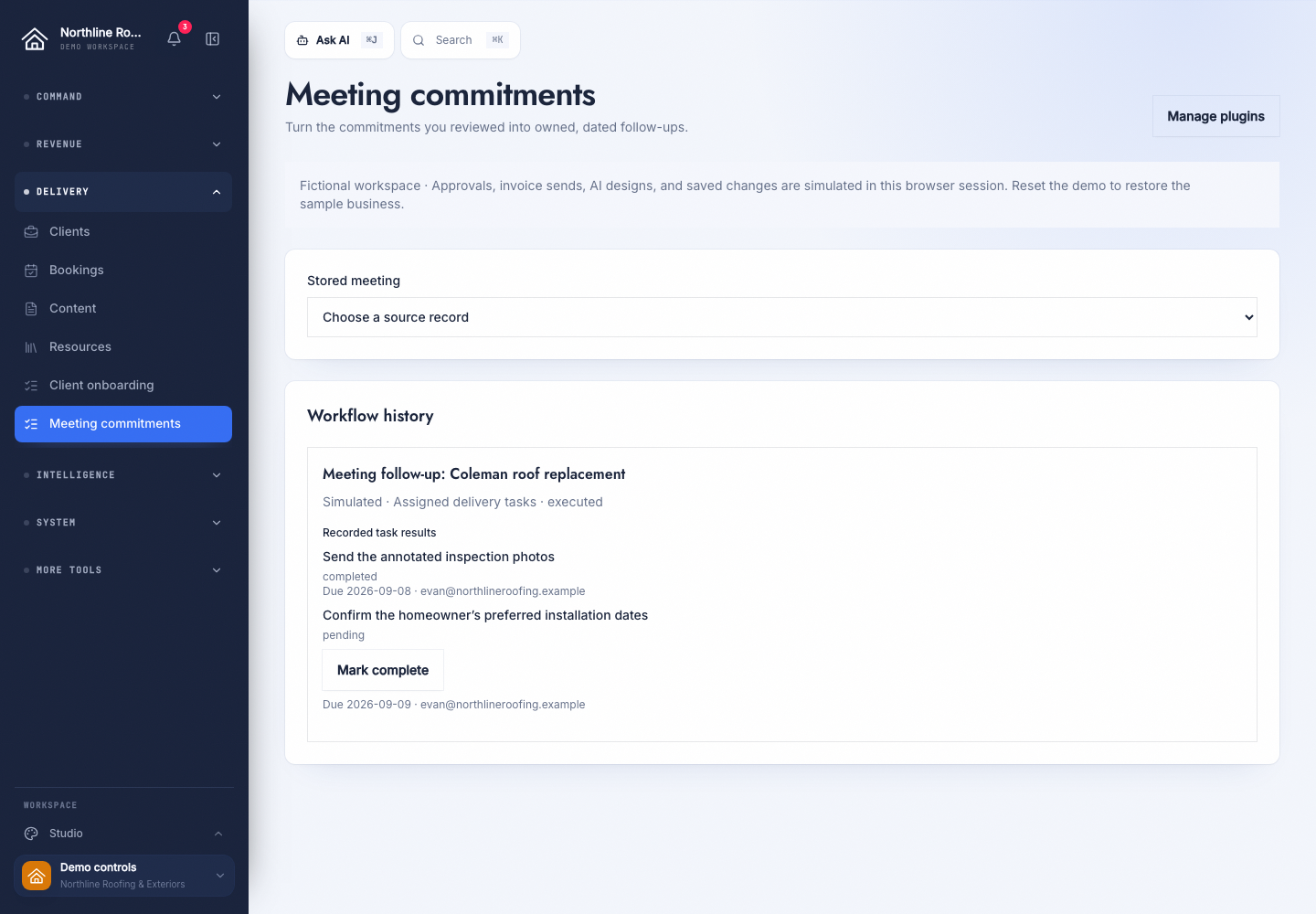
Open Meeting commitments, select the stored meeting and enter the tasks with descriptions, due dates and valid assignees. A plan supports one to ten tasks.
-
Choose Review workflow, then Request approval. Review the source meeting, owners and dates before selecting Approve & create tasks.
-
Inspect the execution result and open the created tasks in Tasks & approvals. Update the tasks as the work happens and retain a useful reference to the confirmation.
Check the result
Each agreed commitment appears as a saved task with an owner, due date and source meeting. The next person reviewing the event planning meeting can see what remains outstanding and who is responsible.
Adapt it for your business
Use the venue calendar and supplier records to verify availability. A planning task tracks responsibility for confirming a detail; the specialist system records the booking.
For a custom connection, use Build an extension and the development brief. Specify the source of truth, permitted data, approval policy and receipt that proves completion. Define duplicate handling and recovery before enabling writes to another system.
What to check
If the meeting is missing, check the calendar connection and the source record. Enter the agreed checklist explicitly; the preparation report identifies upcoming meetings, while research or transcript extraction requires a separately implemented step. Refresh a stale preview before requesting approval.
For an uncertain execution, inspect the original receipt and saved tasks before retrying with the same request identity. Keep the review required by the action policy. Restrict customer data to what the task needs, and keep sensitive records in the authorized specialist system.
Hosted infrastructure and connected providers may have costs. AI conversations use your configured model. Verify the result in the source screen before relying on it.